
 Español
 Français

Blogs for users experience
Electrochemical Etch Marking for Aircraft Maintenance: Reviewing an Electrolyte Against SOPM 20-50-10
Oct
Repair stations and airline maintenance shops put part numbers, serial numbers and repair references on stainless steel and alloy components every working day. When the maintenance manual allows electrochemical etch marking, it is the method of choice for many shops: the mark is permanent, and the part sees no heat, no impact and no stress. On Boeing aircraft, the approved electrolytes and post-etch cleaners are listed in the Standard Overhaul Practices Manual, SOPM 20-50-10. This guide covers what that list actually specifies, which data your engineering department needs to review an electrolyte that is not on it, and how to run a qualification test in your own shop.
What the SOPM 20-50-10 table specifies
The electrolyte and cleaner selection table in SOPM 20-50-10 (Figure 2) is arranged by base material, such as corrosion-resistant steel. For each material it gives:
- Electrolytes by brand name, listed per marking mode.
- A dedicated selection for deep etching, for parts that need a recessed mark.
- Post-etch cleaners and neutralizers for use after marking.
What the table lists are commercial products, not chemistries. Where your work instruction calls out a listed product, that is the product to use. Where your quality system allows engineering to approve an alternative, the approval rests on data, and a supplier who wants to be considered should hand that data over without restrictions.
The data engineering should ask for
Complete composition
It is common for electrolyte safety data sheets to withhold part of the formula as a trade secret. Nothing undisclosed can be compared. Ask for every ingredient with its concentration range in a GHS-format safety data sheet.
pH value
pH indicates how the electrolyte will treat the base metal next to the mark, and what handling it requires. The published safety data sheets of several electrolytes in the SOPM table list acidic values in the range of about pH 1.8 to 3.7.
Chloride level
Chloride speeds up the etching reaction on stainless steel. Left on the part, it is also a pitting risk. Ask for the chloride content as a number, so it can be compared with what your shop already uses.
Neutralization step
A mark is finished only when the residue is gone. The supplier should state the rinse and the neutralizer. Where the maintenance manual names a post-etch cleaner, that requirement stands whatever electrolyte you mark with.
A test panel in the production alloy
No data sheet replaces a test. Mark a panel of the same alloy and heat-treat condition as the part, with the stencil type and marking time you plan to use. Then verify:
- legibility and contrast,
- mark depth, where your procedure calls for one,
- a clean surface around the mark after neutralization, with no etching or staining,
- the marking time, documented for the work instruction.
EUmark M22 at a glance
M22 does not appear by brand name in SOPM 20-50-10. Any evaluation should start from that fact, and the approval of an alternative material belongs to your repair station. Our part is to give your engineers complete data:
| Property | EUmark M22 |
|---|---|
| Chemistry | Nitrate salt with citric acid / citrate, water based |
| pH | 6.5 – 7.0, near neutral |
| Chloride | approx. 1.5 % |
| Nitrate | approx. 3.4 % |
| Disclosure | Every ingredient with concentration range in the SDS |
| After marking | Neutralize with EUmark Neutralyte N11, or the cleaner your manual calls out |
| Documentation | Safety Data Sheet, Product Data Sheet |
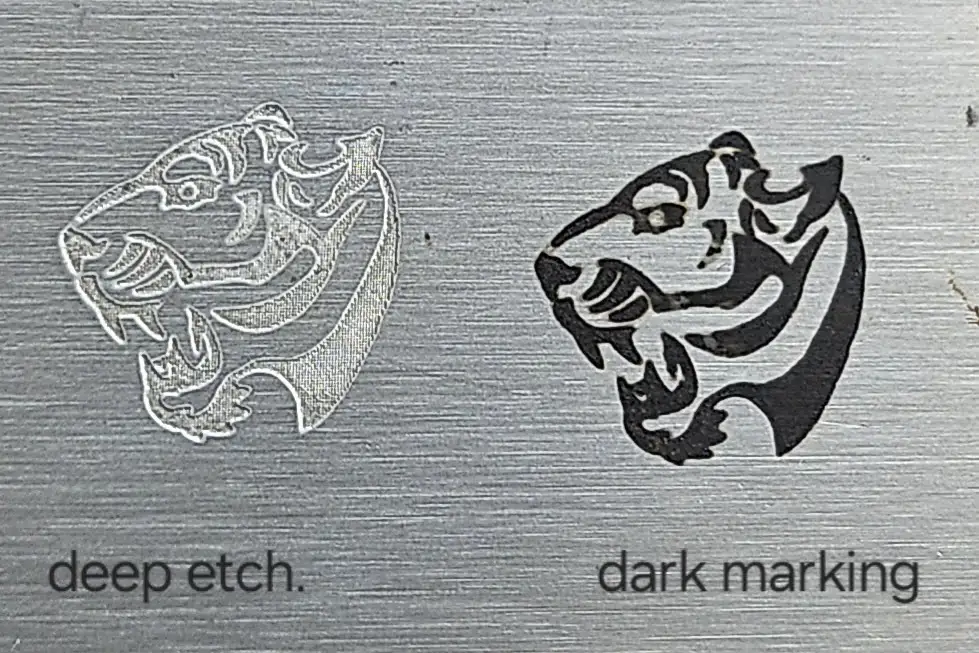
M22 is the electrolyte we formulated for maximum contrast and deep etch. With the same bottle you get either a dark, high-contrast mark or a recessed etched mark, set by the marking mode and time on the unit.
Running the qualification test
- Write down the requirement: base material, mark type (dark or etched), depth if specified, and the post-etch cleaner from your manual.
- Prepare test panels in the same alloy and surface condition as the part. Clean and degrease the marking area.
- Mark a series with stepped marking times, using the same stencil and pad.
- Rinse and neutralize right after each mark.
- Inspect and measure legibility, depth and the surface at and around the mark.
- Document the passing parameters and submit them to your engineering authority.
Everything for this test fits in one box. The EUmark Super Set 04 ships with the marking unit (AC and DC modes), the CD410 stencil printer with stencil tape, electrolytes M21, M22 and M23, Neutralyte N11, marking felt and stencil samples. Your team tests on your alloy, with your inspection methods, and the results stay in your files.
Built for the shop floor
The EUmark Super Set 04 is our most complete system. The unit runs in AC and DC modes for both dark marking and deep etch. The CD410 thermal printer turns any part number, serial number, QR code or barcode into a stencil right at the bench. The system goes to the part, which counts when a component is large, heavy or still in its assembly, and with no heat input, hardened and fatigue-critical parts keep their condition.
Track record
EUmark has built electrochemical marking systems since 2001. Over the past five years, our webshop has shipped to eleven aviation organizations, including repair stations, airline maintenance departments and aerospace suppliers, in the United States, the United Kingdom, France, Belgium, Poland, Italy, Iceland and Australia. Six of them bought complete marking systems, and two have already reordered electrolyte and a stencil printer. A system that stays in use is the best reference we have.
Get the data sheets
If your engineering team is reviewing an etch marking electrolyte, email us and we will send the M22 Safety Data Sheet and Product Data Sheet the same day: eumark@eu-mark.com. Or browse the complete electrochemical marking kits.
Boeing and SOPM are named only to identify the maintenance documentation. EUmark is not affiliated with or endorsed by The Boeing Company.