
 Español
 Français
Blogs for users experience, Blogs how to easy mark or etch
What Makes a Black Mark Black: Electrochemical Oxidation vs. Laser Annealing
Nov
What makes a black mark black
Both electrochemical marking and fiber laser annealing produce permanent black marks on metal. Both are used in serious industrial environments. But they arrive at black by completely different physics, and that difference shows up in how the mark reads under inspection — and in what goes wrong when it does not come out right.
Two different routes to the same colour
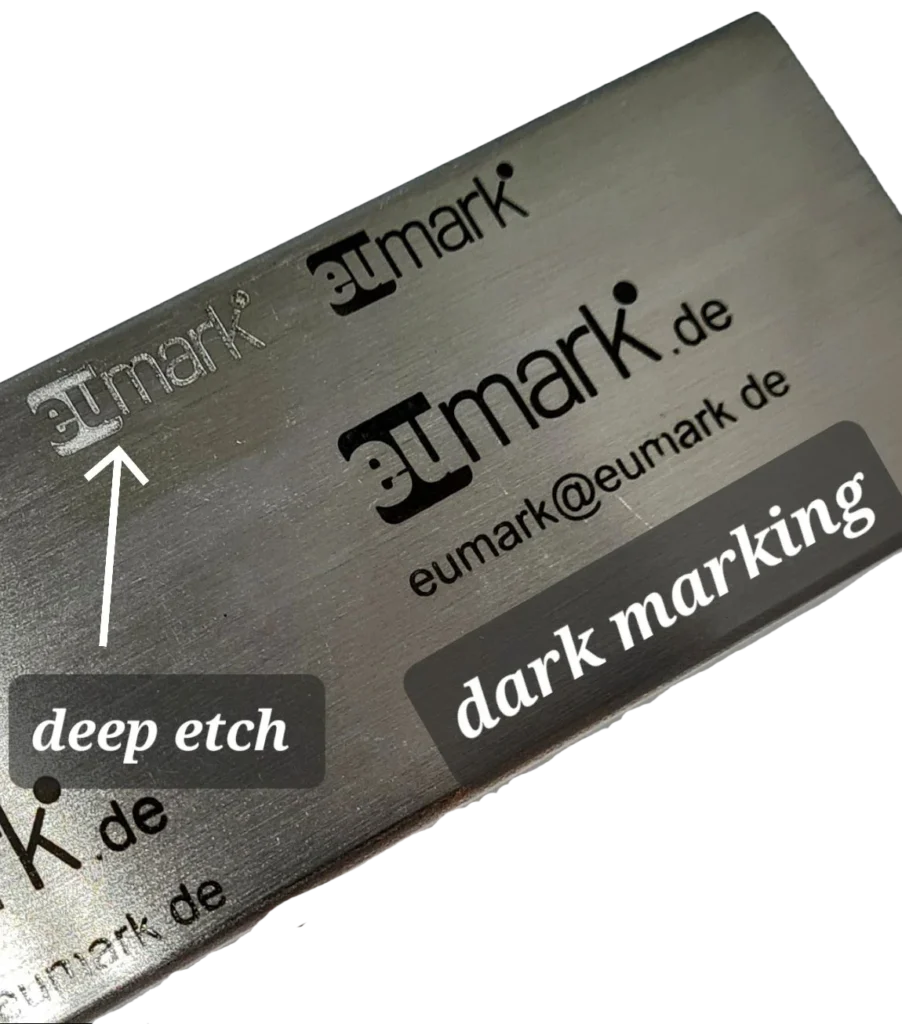
Electrochemical marking produces its mark through a controlled oxidation reaction: a forced, localised change in the metal’s own surface layer. The result is a dense, matte black that reads clearly from any viewing angle, without glare or reflection.
That last point matters more than it sounds. In a quality inspection environment where parts pass under cameras or under human eyes at speed, a matte mark reads consistently regardless of how the light falls. A mark with any specularity can wash out at the wrong angle.
Fiber laser annealing produces black by heating the surface in a controlled way so that an oxide layer forms without ablating material. On the right substrate the result is excellent. But consistency depends on alloy composition, surface finish and precise parameter tuning — on some stainless steels, getting a repeatable high-contrast black takes several test passes to dial in, and a change of material batch can mean dialling it in again.
Cycle time for a fixed design
For a fixed mark — a logo, a part number, a certification mark — electrochemical marking completes an impression in two to five seconds. A full working cycle including wiping the part and loading the next one runs around ten seconds, so roughly six parts a minute at a steady pace.
Laser annealing at the settings needed for deep, consistent black takes longer than a laser’s headline marking speed suggests, particularly on reflective or light-coloured metals where more energy has to go in to build the oxide layer.
Where laser regains the advantage is variable data at volume — thousands of incrementing serial numbers with no stencil to change. For a repeating fixed pattern, electrochemical marking keeps pace or beats it.
Getting the darkest mark: it is the electrolyte
This is the part most often missed. The machine matters less than the fluid running through it.
Of the EUmark electrolytes, M22 is the one formulated for maximum contrast — it produces the darkest mark and is also the fluid used for deep etch. M21 is self-cleaning and delivers a high number of marks from one wetting of the felt, which makes it the right choice for running a batch, but it is built for consistency and throughput rather than absolute darkness. M23 is non-corrosive and formulated for corrosion-sensitive materials.
If a mark is coming out lighter than expected, the electrolyte is the first thing to check, and dwell time the second — contrast builds with how long the stamp is held against the stencil.
When the mark comes out grey instead of black
Three causes account for nearly all of it, in this order:
- Aluminium. This is the most common one and it is a material property, not an operator error. Aluminium forms a non-conductive oxide layer almost immediately on exposure to air, and that layer is what produces a grey, muted result instead of a crisp dark one. Many aluminium alloys also contain magnesium and silicon, which complicates it further. It can be marked, but it needs a different approach and the right electrolyte.
- Wrong electrolyte for the job. M21 or M23 on a part where maximum contrast was wanted will look lighter than M22 on the same part, with everything else identical.
- Dwell time too short. A quick pass gives a light mark. Holding the stamp against the stencil slightly longer darkens it. This is the easiest of the three to fix and the easiest to overlook.
Surface preparation sits underneath all three: the surface has to be degreased before marking, and residue from a previous operation will show up as an uneven mark.
Artwork also decides how black a mark looks
Thin lines, outlined text and open lettering reproduce cleanly. Thick strokes and large solid black areas should be avoided — the electrolyte does not pass evenly through a large closed area of stencil, and the mark comes out patchy rather than solid. Where a logo is heavy, an outlined version of it marks far better than a filled one.
Strokes below about 0.008″ (0.2 mm) tend to close up, whatever produced them.
If you are still choosing between the two technologies
This post is about mark quality. The broader decision — capital cost, surface integrity, portability, geometry, and where a laser is genuinely the better buy — is covered in Electrochemical Marking vs. Laser Engraving: An Honest Comparison for Metal Parts.
If a mark on your own material is not coming out the way you expect, send us a coupon in that alloy. We will mark it here with the settings that produce the best result and send it back, so you have a physical reference to work against. eumark@eu-mark.com